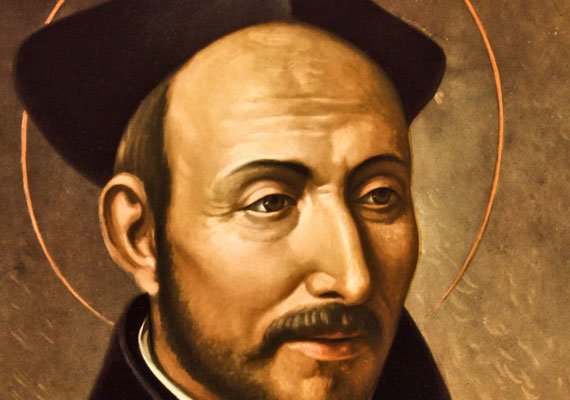
Our Spirituality

Finding God in all things

St Ignatius of Loyola, our founder, developed a spirituality for real life. Referred to as ‘Ignatian Spirituality’ it is commonly described as a way of ‘finding God in all things’. St Ignatius was convinced that God could be found in every area of life, meaning that everything, from relationships to family, from happiness to suffering - everything - is a part of the spiritual life.

Contemplatives in action

If we want to discover God in our lives, we need to take the time to seek Him there. This means stopping, taking moments out of the rush of modern life, to listen for the voice of God. It then means finding the ways of praying that work for you. This counter-cultural way of living is how Jesuits live, and because of this we have been referred to throughout our history as ‘contemplatives in action’.

Ignatian Spirituality has proved itself as a tried and tested pathway to God for millions, a way of navigating life’s complexities, and a spiritual treasure from Catholic tradition for the world.

Ways of praying

A life lived for the greater glory of God

St Ignatius of Loyola is one of history’s giants. In his lifetime, he was many things.

The soldier. The mystic. The pilgrim. The prisoner. The founder. The priest. The saint. He lived his life by a simple but powerful maxim: To live for the greater glory of God. Discover him for yourself.

St Ignatius of Loyola

St Ignatius of Loyola

St Ignatius has real insight into how different people connect with God in different ways, once writing, ‘It is dangerous to make everybody go forward by the same road’. So, find what works for you!

Here you will find many ways of praying, various meditations and reflections, tools for decision-making, imaginative exercises and retreat experiences, all drawing from the richness and tradition of Ignatian Spirituality.

The soldier

1491 - 1522

Ignatius (born Iñigo Lopez de Loyola) was born in 1491 in the castle at Loyola, as the son of a local landowner. Here, in the Basque Country, he was brought up in the cottage of the blacksmith's wife and had little formal education. For much of his youth, Ignatius was, in his own words:

' ... a man given over to the vanities of the world, and took a special delight in the exercise of arms, with a great and vain desire of winning glory' Reminiscences [1]

In the pursuit of such glory, he served as a soldier until he was twenty-six. It was in the army that he was to have an experience that would change his life forever. Whilst defending the town citadel of Pamplona in the name of King Ferdinand of Spain from a vast French army, Ignatius suffered a terrible battle injury. On 20th May 1521, French cannon fire smashed into both his legs.

This traumatic event hospitalised Ignatius for eight months and this served as a period of intense reflection for Ignatius. Ignatius wanted to read tales of chivalry and romance in his bed-bound state, but to his dismay, he found that the hospital only had the life of Christ and the lives of saints available to read. Ignatius found in reading these stories that they awoke something strange inside of him, a desire to live like the saints.

‘For, while reading the lives of Our Lord and the saints, he would stop to think, reasoning with himself: ‘How would it be, if I did this which St Francis did, and this which St Dominic did?’’ Reminiscences [7]

It was also in this period that Ignatius had his first spiritual insight into himself.

‘... from some thoughts he would be left sad and from others happy, and little by little coming to know the difference in kind of spirits that were stirring: the one from the devil, and the other from God.’ Reminiscences [7]

Slowly, Ignatius discovered that the things of his old life no longer brought him joy, but the idea of a new way of living, of living the life of a saint, really did. The dream of doing good deeds for God and imitating the saints by walking barefoot to Jerusalem thrilled him, whereas dreams of romantic gallantry no longer did. This observation of the movements of his soul became a spiritual insight he would later teach to others known as the Discernment of Spirits.

Ignatius entered that hospital a broken soldier but left determined to be a great saint.

The mystic

1522 - 1523

‘Everything is yours; do with it what you will. Give me only your love and your grace, that is enough for me.’ St Ignatius of Loyola

On leaving the hospital, Ignatius made a pilgrimage to the statue of the Black Madonna at the shrine of Montserrat where he planned to lay down his previous life. On arrival, he stayed up all night in a vigil of all-night prayer and even had a confession that lasted for three days!

‘This he decided to keep a vigil of arms for a whole night, without sitting or lying down, but sometimes standing up, sometimes on his knees, before the altar of Our Lady of Montserrat, where he had resolved to abandon his clothes and clothe himself in the armour of Christ … He also arranged with the confessor that he should give orders ... that his sword and dagger should hang in the Church at the altar of Our Lady.’ Reminiscences [17]

Here, he renounced his former ways, with all its vanities, and dedicated himself to his new Master. From this time on, he would live a simple lifestyle, embracing poverty. Having lain down his sword for good, Ignatius threw himself into the spiritual life with zeal. He exchanged clothes with a poor man, then left Montserrat at dawn, to leave unrecognised and to pursue his new life.

From the Benedictine monastery of Montserrat, high among the wild and jagged peaks, Ignatius descended to the bustle of the nearby town of Manresa. For ten months he learned to interpret the way in which God deals with the individual soul. He first punished his body. Reacting against his former tendency to vanity, he cut neither hair nor nails and took no care of his appearance. He begged daily for his meagre food. It was not long before this radical life transformation began to affect him.

‘The difficulty of his way of life would present itself to him, as if it was being said to him inside his soul; ‘And how are you going to be able to stand this life the seventy years you’re meant to live?’’ Reminiscences [20]

This period of Ignatius' life in Manresa was wild and strange. He was tormented by guilt and despair and at some point seriously contemplated suicide. Eventually, he came to see the error of the self-punishment he was putting himself through and realised that the forgiveness of God is free, not bought with self-inflicted penances.

‘But at the end of these thoughts there came to him some feelings of disgust for the life he was leading, and some impulses to cease from it; and with this the Lord willed that he work up as if from sleep. … Thus from this day onward he remained free of those scruples, holding it from certain that Our Lord in his mercy had willed to liberate him.’ Reminiscences [25]

Having changed course, Ignatius learned in a deep way how to make life decisions with God, how to discern better God’s path for him through life, an insight he would share with many in the future. Ignatius stayed for almost a year in Manresa and began to see great spiritual fruit from his time there. Sitting in his cave by the banks of the Cardoner river, he prayed often, and the fruits of his meditation there laid the foundations for his Spiritual Exercises. A moving passage from his biography states that it was in Manresa that he received the greatest spiritual experience of his life, all whilst simply watching the river.

‘One cannot set out the particular things he understood then, though they were many: only that he received a great clarity in his understanding, such that in the whole course of his life, right up to the sixty-two years he has completed, he does not think, gathering together all the helps he has had from God and all the things he has come to know (even if he joins them all into one), that he has ever attained so much as on that single occasion. And this left him with the understanding enlightened in so great a way that it seemed to him as if he were a different person, and he had another mind, different from that which he had before.‘ Reminiscences [30]

The pilgrim

1523 - 1524

‘It is dangerous to make everybody go forward by the same road: and worse to measure others by oneself.’ St Ignatius of Loyola

From Manresa, the pilgrim set out on the long journey to Jerusalem. Braving the dangers of a war-torn Mediterranean, he begged his way to the Holy Land in 1523. From Spain he travelled to Venice, boarding the ship for Jerusalem with ‘nothing with which to feed himself beyond the hope he was placing in God’. In Jerusalem, he spent time devotedly walking in the footsteps of Our Lord.

‘His firm intention was to remain in Jerusalem, forever visiting those holy places. And, as well as this matter of devotion, he also had the intention of helping souls.’ Reminiscences [45]

Ignatius expressed a desire to stay and convert the Muslims, but the more prudent Franciscan keepers of the Holy Places ordered him home. They explained kindly that it would not be appropriate for him to be a missionary there for the following reasons.

‘For many people had had this desire, and then one had been taken prisoner, another had died, and then the order had been left having to ransom the prisoners. He should therefore get ready to go the following day with the other pilgrims.’ Reminiscences [46]

Ignatius was crestfallen that he could not imitate the saints by ministering in these holy places, but accepted that this was the will of God. This dream shattered, he headed home in order to find Christ, not in the romantic notion of converting the world, or living in the land walked so long ago by Jesus, but in the events of daily life in his own country.

The prisoner

1525 - 1528

‘If God causes you to suffer much, it is a sign that He has great designs for you, and that He certainly intends to make you a saint.’ St Ignatius of Loyola

Ignatius’ great desire became to help others see God working in the ordinary events of their own lives. His work was frequently looked upon with suspicion by the church authorities who saw heresy lurking behind every tree, for Europe at the time was in the throes of the Reformation.

Ignatius felt that the best way to be allowed to teach in the Church was by studying philosophy and theology and becoming a priest. So, he settled down to life as a student. In Barcelona, at the age of thirty-three, he went back to school and joined classes of boys to learn Latin, the language of the universities. In 1526, when he had mastered the basics of this ancient language, he moved to Alcalá University to study Philosophy. It was in this town where he gave his Spiritual Exercises to the townsfolk and began to draw crowds!

‘While in Alcalá he was also occupied in giving spiritual exercises and in explaining Christian doctrine, and through this there was fruit borne for God’s glory. There were many people who came to considerable awareness and relish regarding spiritual matters … and there were other things like this which stimulated talk in the town, especially given the great crowd that used to gather wherever he was explaining doctrine.’ Reminiscences [57]

It was then that Ignatius fell foul of the Spanish Inquisition, who travelled from Toledo to investigate his way of life and his teachings. Ignatius was imprisoned in 1527 for teaching religion before his completion of the required training. The severity of the Inquisitors' treatments of people can be felt in a striking part of Ignatius’ biography, in which he has this exchange with a friend,

‘We’d like to know if they’ve found any heresy in us.’ ‘No’, said Figuerao, ‘if they had found it, they’d have burnt you.’ Reminiscences [59]

In the end, Ignatius was imprisoned in Alcalá for forty-two days!

‘At the end of these … the notary went to the prison to read him the verdict: he could go free, they were to dress like the other students and they were not to talk about matters regarding the Faith within the four years that they still had to study, because they weren’t learned.’ Reminiscences [62]

Ignatius would be arrested again in the town of Salamanca by Dominican Friars who were suspicious of Ignatius' lack of education on moral issues. Again, an investigation of his Spiritual Exercises was held and Ignatius had to stand trial before judges. After twenty-two days of imprisonment here, Ignatius and his companion were released, with it being concluded again that there was no heresy in what they taught.

Upon release from prison, Ignatius the student moved from Spain to the freer atmosphere of Paris and Montaigu College, even though France at the time was a treacherous place for a Spaniard!

‘Many prominent people urged him strongly not to go … when he arrived in Barcelona, everyone who knew him advised him against the move to France because of the major wars taking place, recounting to him very specific examples, to the point of telling him that they were roasting Spaniards on spits. But he never had any kind of fear.’ Reminiscences [72]

The founder

1528 - 1535

On arrival in Paris, academic study alone could not satisfy Ignatius. A desire was growing in Ignatius’ heart to do this work for God with companions.

‘Now, since at this time of being imprisoned in Salamanca these same desires that he had hadn’t gone away - of doing good for souls, or studying first with this end in view, of gathering together some people with the same intention and of keeping those he already had.’ Reminiscences [71]

He gathered about him young men whom he fired with enthusiasm to serve the Lord. He gave the Spiritual Exercises while continuing his studies of philosophy at the University. These included six key companions, namely, Francis Xavier, Alfonso Salmeron, Diego Laynez, Nicholas Bobadilla, Pierre Favre and Simão Rodrigez.

To finance his studies, Ignatius would spend a little time each year in Flanders begging for alms. In the summer of 1530, he went further afield to London. The generous Londoners gave him much more than he had collected previously - sufficient, to keep him for the whole year.

On 15th August 1534, one of their number, Pierre Favre, said Mass in a chapel on the slopes of Montmartre where they all took vows of poverty and chastity and, further, promised that upon completion of their studies, they would make a pilgrimage to the Holy Land. They agreed to meet in Venice to embark from there. On that day, the ‘Society of Jesus’ was founded, with those companions all as co-founders. Their great mission was now ahead of them.

‘And already at this time they were all resolved on what they were to do, namely, to go to Venice and Jerusalem and to spend their lives in what was beneficial to souls. And if permission was not given them to remain in Jerusalem, they were to return to Rome and present themselves to Christ’s vicar [the pope], so that he could employ them wherever he judged to be more for the glory of God and the good of souls.’ Reminiscences [84]

The priest

1537 - 1556

The agreed meeting took place, but the companions waited in vain for a pilgrim ship to the Holy Land. The normal dangers of wind and weather were added to that of war with the Turks. However, what happened during the wait was more significant than any pilgrimage could have been. It was during this time that Ignatius, and those of the companions who were not yet priests, were ordained on 24th June 1537. Ignatius, however, waited until Christmas Day 1538 before celebrating his first Mass, such was his devotion to the Eucharist and his low estimation of his own worthiness to celebrate it.

In July 1537, the companions left Venice for nearby Vicenza, still awaiting their passage. Here they began ministry, tending the sick and helping the poor, while they themselves lived in destitution. In order to attract an audience for their preaching, they cavorted and threw their caps in the air, and then, in a hilarious mixture of languages, these men from Spain and France preached to the Italians.

‘And with each of the four going into different squares on the same day and at the same hour, they began their sermons first shouting loudly and calling the people with their caps. With these sermons there arose a great deal of talk in the city, and many people were moved with devotion.’ Reminiscences [94]

Early in 1538, the companions, whose number had now grown to nine, decided to go to Rome to put themselves at the disposal of the Holy Father. During the journey, Ignatius had a memorable vision where God the Father 'placed him with his Son' carrying His cross. Following Christ crucified, Ignatius continued to Rome.

Ignatius and his companions considered long, hard and prayerfully whether to band together formally. They decided that they would be more effective together than apart and so, in 1540, with the blessing of Pope Paul III, the Society of Jesus was officially born.

They dedicated themselves to teaching, to preaching the word of God, to working with the poor and the sick in the slums of the cities of Europe, and to travel to far-flung destinations to preach Christ to people in lands new to European eyes. The new religious order had chosen to be flexible to meet the demands of the new age of Reform and Reformation. Gone was the monastic meeting together many times daily to sing God's praises as a community. Gone too was the requirement of wearing a distinctive habit; now each man worshipped God in the way he found best and was totally free to respond to the needs of those around him.

The Jesuit 'community' was maintained over vast distances by means of the pen. They were to be educated men who could debate with the reformers on their own terms; men who would not be seduced by worldly power and wealth; men who sought to convert whole nations to Christianity; willing to do anything for the greater glory of God.

Ignatius of Loyola was elected by his first companions as Superior General of the Society of Jesus, so he remained tied to an office desk in Rome writing letters to men who, like Francis Xavier, matched him in fame - letters which encouraged, which made requests, which chided; letters telling of everyday events, and of outstanding feats. The playboy, the soldier, the pilgrim had to learn to watch others doing the adventurous deeds while, for sixteen years, he supervised and organised the building up of the Society of Jesus and its movements across the world. Indeed, he became one of the most prolific correspondents in Europe during the 16th century: over 7000 of his letters still survive.

The saint

Legacy

St Ignatius died on 31st July 1556 at the age of 65. He was beatified by Pope Paul V in 1609, canonized by Pope Gregory XV in 1622, and declared patron of all spiritual retreats by Pope Pius XI in 1922. Ignatius' feast day is celebrated on 31st July. In his Spiritual Exercises, he repeats a phrase often, a phrase in which he articulates the purpose of life,

‘Man is created to praise, reverence, and serve God Our Lord and by this means to save his soul’.

Ignatius never lost sight of his purpose, or his quest to reveal this to others. Today, we still have all the spiritual ways that he taught people then, all fruits of his life lived in relentless pursuit of God. Why not discover this spirituality for yourself?

Jesus Christ

When God became human

The name, ‘The Society of Jesus’ – the proper title for the Jesuits – captures the essence of who we are and what we are about. Throughout our history, our passion has been helping people towards an ever-deeper and ever-fuller personal relationship with Jesus Christ. At its heart, all Ignatian Spirituality and Jesuit thought draws from the life and teachings of Jesus of Nazareth. He is our source and our inspiration.

Why are the Jesuits also called ‘The Society of Jesus’?

St Ignatius, one of the founders of the Jesuits, built his Spiritual Exercises on the life and example of Jesus. He believed that the more we came to know Jesus, the more we would grow to love Him – a love that would then draw us into deeper service of God and the world.

Indeed, so central was Jesus to St Ignatius, that he prayed to be given the honour of serving Him. He wished that he and his own companions, the first Jesuits, could also be companions of Jesus – being close to Jesus so they could become more like Him in all they did, but also so that they could help others to see something of Jesus in and through their actions.

The prayer of St Ignatius was answered in one of his most important visions, at La Storta on the way to Rome. He saw Christ carrying his cross and heard God the Father say to Jesus, ‘I wish you to take this man [Ignatius] for your servant’ and Jesus, in turn, spoke to Ignatius, confirming that ‘My will is that you should serve us’.

The name Ignatius and his first companions chose for their new group emerged also from this vision. It was clear to them that they had to take the name the ‘Company of Jesus’ because Jesus alone was their head. It was Jesus who had taken them all into His company, and that made them companions of Him, as Ignatius had so fervently wished; but they were also companions of each other, friends in the Lord, alongside Jesus, carrying His cross.

We want to introduce you to Jesus as we have come to know Him – as the person who has transformed our lives. So, who was Jesus of Nazareth? Why does He continue to bring new life and hope to people all around the world? What is so life-changing about His teaching and what can happen if you let Him enter more and more into your life?

Who is Jesus?

Simply put, Jesus of Nazareth, Jesus the Christ, is someone worth getting to know. He is the most important person ever to have lived – someone who has literally changed the world. Historically, of course, there is the vast and rich cultural influence of Christianity, but what is most important of all is that Jesus also changed the world at a much, much deeper level.

We can see something of this in those chaotic days around His death. His friends had scattered in fear, unable to deal with His humiliating and violent crucifixion (a particularly cruel Roman punishment for slaves and rebels). And yet, these people, who had denied Jesus at the moment of His greatest need, who had abandoned Him, were turned around completely by an event that none of them had anticipated – His rising from the dead. As a result of their encounters with the risen Jesus, instead of hiding and fleeing they now stood up and publicly proclaimed what they had seen, even though it would mean their own violent deaths.

Right from these first transformational moments, as Jesus’ friends and followers tried to put what they had experienced into words, they could only find one credible explanation for all that they had seen and heard. They began to describe Jesus in ways that, up to that point, had only been used to describe God.

‘God highly exalted him and gave him the name that is above every name, so that at the name of Jesus every knee should bend, in heaven and on earth and under the earth.’ Phil 2:9-10

Jesus was recognised as sharing in a special way in the unique identity of God. From the very first generation of Christians, people called him God. That is why today, we also proclaim that Jesus of Nazareth is the Son of God. We believe that He is both fully God and fully human.

Jesus, Son of God

Through Jesus, humanity came to a fuller understanding of God. Why would God choose to become part of His own creation? The short answer is that it was the culmination of God’s self-introduction to humanity.

‘Long ago God spoke to our ancestors in many and various ways by the prophets, but in these last days he has spoken to us by a Son.’ Hebrews 1:1-2

More than this, it was God’s way of bringing us closer to Him. This was Jesus’ mission and the goal of His life, to bring us back to full unity with God the Father, by showing us the depth of God’s love.

God entered the human experience to break the power of sin and death in the world and, through the example of the Son, to model for us a new way of living. As Pope Benedict has taught:

‘In Jesus of Nazareth we encounter the face of God, who came down from his heaven to immerse himself in the human world, in our world, and to teach “the art of living”, the road to happiness; to set us free from sin and make us children of God.’ Pope Benedict XVI

Jesus, Son of Man

Through Jesus, God knows exactly what it means to be human. Don’t forget, Jesus was a son, a friend, a person who mourned and a person who suffered. He knew what it meant to be rejected, to be abandoned by those closest to Him. He saw his life collapse in the course of just twenty-four hours. He experienced every human emotion.

He knew the joys of family and friendship, the satisfaction of work, the powerful call of vocation. He played and laughed, grew and learned. He faced temptation but knew always to turn to His Father and trust in God.

How can we forget the way Jesus lived? How He turned words into action as He sought to break down barriers between people, bringing in those who were at the margins of society through a radical and, at the time, shocking table-fellowship. How He healed those who had been forgotten. How He challenged those who misused their power and wealth. How He kept God and love at the centre of everything.

What did Jesus teach?

At the heart of Jesus’ teaching are some very simple lessons. The first is that God is love and that God loves each of us in the same way. No matter who we are or what we have done, God does not stop loving us.

Jesus repeatedly taught that God invites all of us to share in the promise of new life. There is no ‘in-group’ or excluded, no advantage for the rich or powerful. The ways of the world are turned on their head. All are welcome, equally, because God’s love and mercy are all-embracing.

The image Jesus offers is of a royal banquet with the Father as a generous host who tells his servants to “go into the main streets, and invite everyone to the wedding banquet”, with a welcome extended to “both good and bad” so that the wedding hall is “filled with guests” (Matt. 22: 9-10). None of us ‘earns’ the invitation, but we all receive one. It is God’s love that gets us there. Our task is to put our best foot forward, accept the invitation, and just as Jesus did to His Father, and as much as we can, say ‘Yes’ to God every day.

Jesus came to bring us into a new relationship with God and with each other.

The good news of Jesus Christ

Jesus talks about the gospel, which means the good news, at the very beginning of His public ministry.

‘ … Jesus came into Galilee, proclaiming the good news of God, and saying, “The time is fulfilled, and the kingdom of God is at hand; repent, and believe in the gospel.”’ Mark 1:14

He calls us to ‘repent’, that is, to turn to God and to seek a new and better way of living. We might call it a conversion of heart and mind, as we come more and more to live lives of love. God knows that we struggle sometimes and that we can often do things that hurt others, or that push God away. That is why Jesus asks us to recognise not only our failings but also God’s transforming love.

God’s unfathomable mercy and generosity are shown in Jesus’ story of the Prodigal Son. The young man left with half the family wealth and wasted it, before being forced to return home broken and penniless. The father did not scold or punish his wayward child but embraced him and threw a huge party to celebrate his homecoming. This is the God that Jesus is showing us – a God whose love overflows, whose gift of love he simply wants us to accept and share.

Jesus wants us to accept God’s love and, bit by bit, to come also to live and share God’s love. He wants us to be the best version of ourselves. This is Jesus’ Good News. As he says,

‘I have come that they may have life, and have it to the full.’ John 10:10

Love your neighbour

As Jesus showed us, the Christian life at its best is about self-giving. He lived not for Himself, but for the glory of God and in service of others, and He asks us to do the same. As He taught

‘ ... you shall love the Lord your God with all your heart, and with all your soul, and with all your mind, and with all your strength’ . . . [and] ‘You shall love your neighbour as yourself.’ There is no other commandment greater than these.” Mark 12:30-31

Of course, Jesus did not just teach others to love their neighbour, He also lived out this teaching in radical ways. The New Testament is filled with stories of Jesus ministering to, and reaching out to those on the margins, to the outcasts of his society. And He calls on each of us to do the same:

‘The king will say to those at his right hand, “Come, you that are blessed by my Father, inherit the kingdom prepared for you from the foundation of the world; for I was hungry and you gave me food, I was thirsty and you gave me something to drink, I was a stranger and you welcomed me, I was naked and you clothed me, I was sick and you cared for me, I was in prison and you visited me.” Then the righteous will answer him, “Lord, when was it that we saw you hungry and gave you food, or thirsty and gave you something to drink? And when was it we saw you a stranger and welcomed you, or naked and gave you clothing? And when was it we saw you sick or in prison and visited you?” And the king will answer them, “Truly I tell you, just as you did it to one of the least of these who are members of my family, you did it to me”.’ Matthew 40:34-40

What did Jesus say about prayer and spirituality?

Prayer is about speaking to God from our hearts and, in doing so, coming to know God in a new and deeper way. It is about opening ourselves to God’s presence in our lives so that God can help us discover the right path to follow. We see this from Jesus’ own example.

For Jesus, prayer is personal.

Prayer, for Jesus, is about relationship. He speaks to His Father with love and intimacy. In the gospel, when He has a big decision to make or is faced with hardship, He spends time in prayer. He speaks and listens to His Father and, in His great prayer, the Our Father, He invites us to do the same.

‘Pray then in this way: Our Father in heaven, hallowed be your name.
Your kingdom come.
Your will be done, on earth as it is in heaven.
Give us this day our daily bread.
And forgive us our debts, as we also have forgiven our debtors.
And do not bring us to the time of trial, but rescue us from the evil one.’ Matthew 6:9-13

In Ignatian spirituality, the idea of prayer as a conversation with God is important. Often at the end of a time of prayer, we are invited to speak to Jesus, or the Father, with the same intimacy and trust as we would with our closest friends.

Jesus prays from the heart

He asks us to speak simply and from the heart.

Jesus is also clear about using normal language when we pray to God. God the Father knows us intimately and this means we can be totally honest, totally ourselves:

‘And in praying do not heap up empty phrases as the Gentiles do; for they think that they will be heard for their many words. Do not be like them, for your Father knows what you need before you ask him.’ Matthew 6:7-8

Often this simplicity can be found in the traditional prayers of the Church. One that was important to Saint Ignatius, is the great prayer to Jesus, the Anima Christi:

Soul of Christ, sanctify me.
Body of Christ, save me.
Blood of Christ, inebriate me.
Water from the side of Christ, wash me.
Passion of Christ, strengthen me.
O Good Jesus, hear me.
Within your wounds hide me.
Permit me not to be separated from you.
From the wicked foe, defend me.
At the hour of my death, call me
and bid me come to you
That with your saints I may praise you
Forever and ever. Amen.

And he knows that prayer can and does change us, and the world.

Jesus says that if we pray about the most important things in our lives, God will hear us and answer us. If we are troubled or have a big decision to make, God will shine a light and show us the way ahead:

‘Ask, and it will be given you; seek, and you will find; knock, and the door will be opened to you. For everyone who asks receives, and he who seeks finds, and to him who knocks the door will be opened.” Matthew 7: 7-8

Why did Jesus die?

Very few would now deny that, as a historical fact, Jesus was crucified and died. Crucifixion was a brutal form of execution used by the Roman Empire to make a public example of wrongdoers by nailing them to a cross for all to see. But why did this happen?

It is important to recognise, first, that Jesus did not just die, he rose again. It is the two together that reveal the full meaning. Through his death and resurrection, Jesus showed that death is not the end. In our world, many believe that after death there is nothing, but Jesus shows us the opposite – after death, there is everything, the fullness of life in God’s presence for eternity.

Jesus died at the hands of an angry mob, whipped up to believe that they were doing God’s will. And so the Cross teaches us a second important lesson – vengeance and violence are not God’s way. Jesus was the innocent victim of violence, and God’s response was not violence in return, but forgiveness. The Cross is a sign that even in the face of the worst that we can do, God remains steadfast in love and mercy.

The New Testament also tells us that Jesus died to save us. This is why common titles for Jesus are ‘saviour’ and ‘redeemer’. Through His death, the sins of humanity were forgiven, and we are fully reconciled to God. As St Paul describes it:

‘God has rescued us from the power of darkness and transferred us into the kingdom of his beloved Son, in whom we have redemption, the forgiveness of sins.’ Colossians 1:13

Because of this, the Cross transformed from an instrument of torture into the greatest symbol of hope in the world. St Ignatius prayed to understand more deeply what Jesus’ actions meant:

‘Christ comes to be born in extreme poverty and after so many labours, after hunger, thirst, heat and cold, outrages and affronts, he dies on the cross, and all this for me’. Spiritual Exercises [116]

It is a good way for us to reflect on what the life, and death, of Jesus means for all of us.

Did Jesus rise from the dead?

Christianity has always taught that Jesus rose from the dead based on the personal accounts of those for whom it was a transformational experience. Simply put, without the Resurrection, Christianity would not exist. The very essence of the first Christian proclamation was Jesus’ resurrection. The disciples could not be silenced because their encounters with the risen Jesus had changed them to their very core. They turned from cowering in fear or fleeing, to boldly proclaiming an event that was ‘a scandal for the Jews, and foolishness for the gentiles’ 1 Corinthians 15:3-6

St. Paul spoke about some of these direct encounters with the risen Jesus when he wrote to one of the earliest Christian communities:

‘For I delivered to you as of first importance what I also received, that Christ died for our sins in accordance with the scriptures, that he was buried, that he was raised on the third day in accordance with the scriptures, and that he appeared to Cephas, then to the twelve. Then he appeared to more than five hundred brethren at one time, most of whom are still alive’. 1 Corinthians 15:3-6

Belief in the resurrection is an act of faith, but we can find evidence of its power in our own lives and in the world around us. In nature, the rhythm of life does mean new shoots emerging every year – death is overcome time and again; life can reach into the most difficult or seemingly inhospitable of places. And that is because life is a stronger force.

Even in the darkest and most difficult experiences of our lives, we know that new life can and does also emerge. As Pope Francis reminds us:

‘Christ’s resurrection is not an event of the past; it contains a vital power which has permeated this world. Where all seems to be dead, signs of the resurrection suddenly spring up. It is an irresistible force.’ Pope Francis, The Joy of the Gospel

How can we know Jesus today?

Spending time with Him in prayer

The easiest way for you to connect with Jesus today is to pray to Him. In the last words that Jesus speaks in Matthew’s gospel, He promises, ‘I am with you always, to the close of the age.’ Matthew 28:20

Knowing this, you can be bold in praying to Jesus, knowing that He cares about the details of your life. Pope Francis advises being completely honest when praying to Jesus. ‘Jesus likes to see the truth of our heart. Don't pretend in front of Jesus. With Jesus, always say what you are feeling.’

Reflecting on what He said

The majority of what is known about Jesus’ life comes from the Bible, specifically the Gospels. Here, you can find detailed accounts of what Jesus was like, how He spent His time on Earth, the stories He told and the things He cared about.

St Ignatius invites us to spend time getting to know Jesus through the stories of His life. One powerful way of connecting to Jesus through Scripture is by imaginative prayer.

Opening ourselves to the Holy Spirit

Through the Holy Spirit, God is active and present in the world today. Jesus spoke of the important role of the Spirit:

‘But the Counselor, the Holy Spirit, whom the Father will send in my name, he will teach you all things, and bring to your remembrance all that I have said to you. Peace I leave with you; my peace I give to you; not as the world gives do I give to you. Let not your hearts be troubled, neither let them be afraid.’ John 14:26-27

Discovering Jesus in His Church

Christianity teaches that Jesus established a Church on Earth. One of the most powerful images of the Church is as the ‘mystical body of Christ’. It represents difference but also unity; each part of the body has its distinctive shape and function, but we all need each other, we work best together. This idea of communion is another powerful image for the Church – we are a community, something that is increasingly precious in this current age.

We invite you to join or deepen your involvement, in the community of the Church, perhaps through one of our Jesuit parishes.

Meeting Jesus in the service of others

During his life on Earth, Jesus spent his time with those on the margins, with the poorest, the outcasts, those suffering illness or rejection. There can be no clearer sign that this is also where we will encounter Jesus in the world today.

In the Beatitudes, Jesus shows his love and concern for those who are suffering and oppressed. They offer a model for how we can serve the world today.